
If you’ve ever had to send more than one invoice for a single job, whether it’s a website build, a renovation, or a long term consulting engagement, you’ve had to work out how to bill for progress.
Do you bill the individual line items as they’re completed? Or do you take a 30% deposit up front, 50% at the halfway mark, and the final 20% on completion?
Billing line by line feels like the more precise option, but it usually isn’t.
Line by line looks precise, right up until you try it
Say you’re quoting a new website. Your quote has three items on it:
- Design
- Copywriting
- Coding & Development
The deposit is easy either way. It’s agreed when you write the quote, and Quotient raises it the moment the customer accepts.
The trouble starts on the next one. You’re partway through the job and you want to invoice the progress you’ve made. If you’re billing by line item, you now have to work out exactly how much of each line you’ve actually delivered. Design is done. Copywriting is most of the way there. Coding has barely started.
So you’re doing maths across every line. Every single time.
Then the customer adds something, or swaps an item out, and you’re recalculating the whole lot from scratch. It’s fiddly, it’s easy to get wrong, and it pulls you away from the work you’re actually getting paid for.
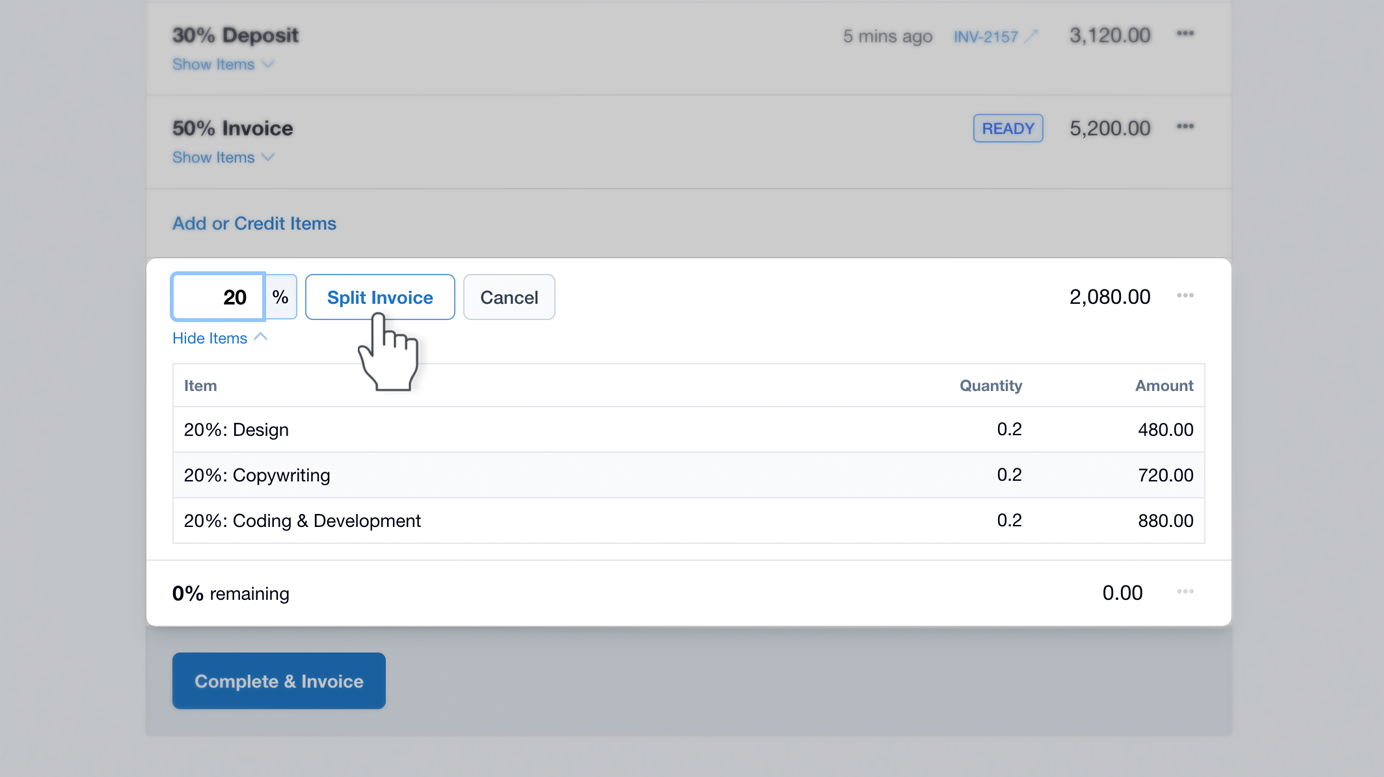
With a percentage, there’s nothing to work out. You type a number, hit Split Invoice, and get back to work.
You still get a breakdown, it’s just proportional
Splitting by percentage doesn’t mean handing your customer one mystery number.
Every split still shows the items. A 20% split on a $10,400 job looks like this:
| Item | Quantity | Amount |
|---|---|---|
| 20%: Design | 0.2 | 480.00 |
| 20%: Copywriting | 0.2 | 720.00 |
| 20%: Coding & Development | 0.2 | 880.00 |
Same items your customer already agreed to, at the same proportions. Nothing to renegotiate.
When a customer asks for a breakdown, they’re rarely after a forensic audit. They want reassurance that they’re being charged fairly, and every line is labelled with the percentage it represents, so that reassurance is built in.
Percentages get you paid sooner
“That’s the job finished, so the final 20% is due” takes seconds to action and seconds for your customer to check. When you’re juggling several jobs at once, those seconds add up to hours back every month.
And because there’s nothing to unpick, invoices spend less time sitting in someone’s “I’ll look at this properly later” pile.
Keep the detail where it belongs, in the quote
The place for detail is your quote. That’s where you set out what’s included, what isn’t, and how the job is structured. It’s where you build trust and win the work.
Once the customer has accepted, every invoice after that is about progress, not a line by line re run of a decision they’ve already made.
It scales with you
The bigger your business gets, the more line by line billing hurts. More jobs, more subcontractors, more tracking of which parts of which quotes have already been billed.
Percentages just keep working. A 30/50/20 on one job. A straight 50/50 on the next. Four 25% splits on the long one. Same approach whether you’re running two jobs or twenty. And Quotient tracks what’s left, so you always know exactly how much of the quote is still to invoice.
Precision, minus the maths
Line by line billing sounds like precision. Progress invoicing by percentage is precision without the overhead.
Your customer gets a breakdown they can actually read. You get to send the invoice in about ten seconds and get back to the job.
Ready to try it? With Deposits, Split Invoices, and Adjustments in Quotient, your deposit invoice is created automatically on acceptance, you can invoice at any stage in percentages, and you can add or credit items after acceptance without the mess.
Keep your quotes detailed. Keep your invoicing simple.
Learn more: